
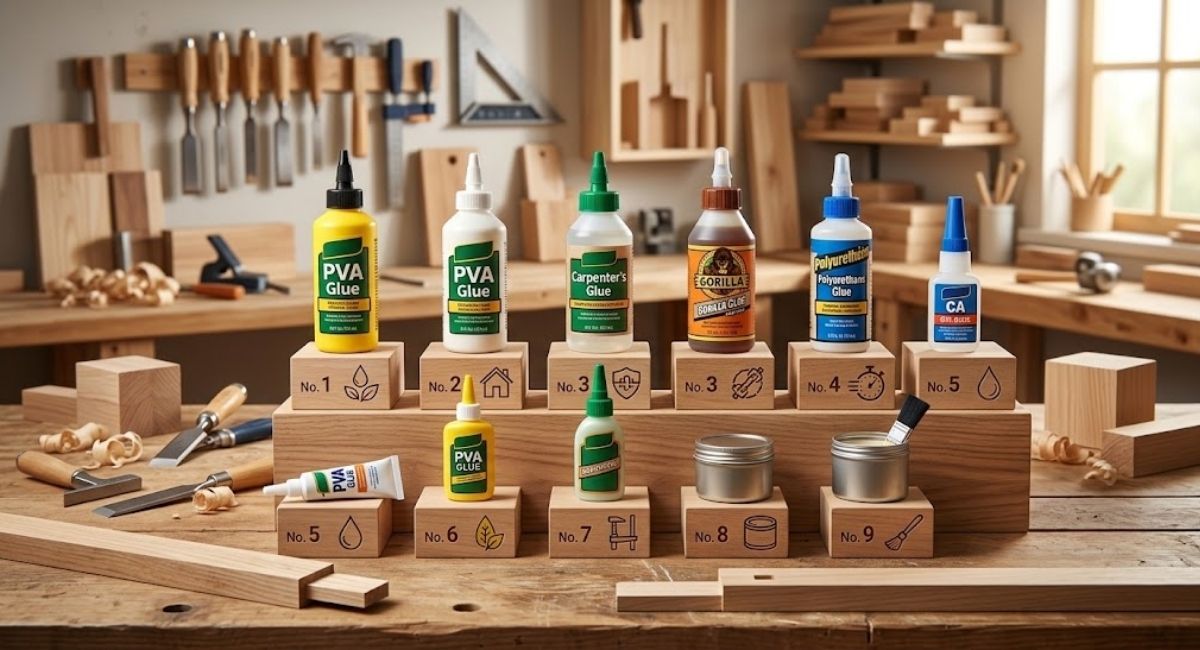
Choosing glue for a woodworking project can look simple until you stand in front of a shelf filled with yellow PVA, polyurethane, epoxy, hide glue, CA glue, and several products that all claim to create a strong bond.
The wrong choice can cause more than a messy glue line. A joint can creep, fail under moisture, become difficult to repair, or leave an ugly mark across an otherwise clean project.
The good news is that you do not need a different adhesive for every project. You need to understand what each type does well, where it has limitations, and how much working time your joint requires.
For most everyday woodworking, a quality PVA wood glue remains the practical starting point. Titebond Original, Titebond II, and Titebond III cover a large part of normal furniture and woodworking work. Gorilla Wood Glue is another strong PVA option. Polyurethane glue, epoxy, hide glue, and CA glue become more useful when the material, joint, moisture exposure, repair requirements, or gap size changes.
This guide compares nine of the most useful wood glue types and products by dry time, practical bond strength, water resistance, and best use. The comparison focus follows the supplied brief, including dry time, strength, and water resistance.
The goal is not to declare one adhesive the winner for every project. The goal is to help you choose the best wood glue for woodworking based on the joint in front of you.
Quick comparison: 9 best wood glues for woodworking
The strength ratings below are practical woodworking ratings, not directly comparable laboratory measurements. Actual joint strength depends heavily on wood species, joint design, surface preparation, glue coverage, moisture content, clamping, temperature, and curing conditions.
| Glue or type | Typical working or clamp time | Practical bond strength | Water resistance | Best use |
| Titebond Original | About 30 min clamp | Excellent on wood | Interior | Furniture, cabinets, general woodworking |
| Titebond II Premium | About 30 min clamp | Excellent on wood | Type II, water resistant | Indoor and many outdoor projects |
| Titebond III Ultimate | About 30 min clamp | Excellent to very high | Type I, waterproof | Outdoor furniture, kitchens, high-moisture work |
| Gorilla Wood Glue | 20 to 30 min clamp | Excellent | Type II | General woodworking |
| Gorilla Wood Glue Ultimate | 20 to 30 min clamp | Excellent to very high | Type I, waterproof | Outdoor furniture and demanding joints |
| Polyurethane glue | Often 1 to 2 hr clamp | Very high | Waterproof | Mixed materials, exterior repairs, gap-prone joints |
| Two-part epoxy | Depends on formula, often 5 min to several hours set | Very high | Usually excellent | Repairs, gaps, mixed materials |
| Hide glue | About 20 to 30 min assembly for liquid formulas | Excellent | Poor for wet exposure | Restoration, musical instruments, reversible joints |
| CA glue | Seconds to minutes | High for small joints | Varies | Small repairs, carving, cracks, quick bonds |
The table gives you a starting point. The details below explain why these adhesives behave differently.
What makes a wood glue strong?
The strongest wood glue is not necessarily the adhesive with the highest number printed on the bottle.
A good wood joint begins with good woodworking.
The mating surfaces need to fit properly. The wood should be reasonably dry and stable. The surfaces should be clean and free from excessive dust, finish, burnishing, or machining defects.
Titebond recommends preparing a good bonding surface by sanding or planing the wood immediately before gluing. It also warns that boards with different moisture contents can create problems in edge-glued panels, such as tabletops and cabinet doors.
Joint design matters just as much.
A properly fitted long-grain-to-long-grain joint gives PVA glue a large bonding area. A poorly fitted joint with large gaps may need a different adhesive or, better yet, better joinery.
This is why simply asking for the “strongest wood glue” can produce a misleading answer.
For a well-fitted furniture joint, a standard PVA can be extremely strong. For a broken carved piece with a small gap, epoxy or CA glue may be more useful. For an exterior project exposed to rain, a waterproof adhesive is more appropriate.
The adhesive needs to match the job.
1. Titebond Original Wood Glue, best for everyday interior woodworking
Titebond Original remains one of the classic choices for woodworkers.
It is an aliphatic resin, commonly grouped with PVA-style woodworking adhesives, and is designed primarily for interior woodworking. Titebond describes it as an industry-standard general woodworking glue with strong initial tack, good sandability, and water cleanup while wet.
For furniture, cabinets, trim, picture frames, veneering, and general shop projects, it is difficult to justify making the choice more complicated than this.
Why Titebond Original works so well
The biggest advantage is predictability.
You apply it to properly prepared wood, assemble the joint, clamp it, clean the squeeze-out, and let it cure.
It does not expand like polyurethane glue. It does not require mixing like epoxy. It does not have the reversibility of hide glue. It simply does the main job most woodworkers need.
Titebond states that its Original, II, and III formulas provide strong initial tack and approximately 30 minutes of clamp time under appropriate conditions.
Best uses
Titebond Original is particularly suitable for:
- Indoor furniture.
- Cabinets.
- Shelves.
- Boxes.
- Picture frames.
- General joinery.
- Edge-gluing boards.
If you are building your first project after reading a guide to beginner woodworking projects, this is one of the simplest adhesives to keep in the workshop.
Limitation
Do not choose Titebond Original for a project that will experience significant outdoor moisture simply because it bonds wood well. It is intended for interior work.
2. Titebond II Premium, best for interior and moderate outdoor use
Titebond II Premium takes the familiar PVA format and adds stronger water resistance.
Titebond identifies it as an interior and exterior woodworking adhesive that passes the ANSI/HPVA Type II water-resistance specification. The manufacturer also highlights its strong initial tack and shorter assembly time compared with Titebond III.
This makes Titebond II a useful middle ground.
You get a familiar water-based woodworking glue while gaining more protection against moisture than you get with Titebond Original.
When should you use Titebond II?
It is a sensible choice for:
- Indoor furniture that may experience occasional moisture.
- Covered outdoor projects.
- Garden-related woodworking with limited exposure.
- Cabinets and utility furniture.
- General repairs.
- Projects where you want stronger water resistance without moving to polyurethane or epoxy.
Titebond classifies Type II as water resistant rather than waterproof. That distinction matters.
A project that sits under a covered porch is very different from a table exposed to constant rain.
Titebond II versus Titebond Original
If the project stays indoors and moisture is not an issue, Original is usually enough.
If the project could encounter more moisture, Titebond II provides a useful upgrade.
If the project will regularly face substantial moisture, Titebond III is the more appropriate Titebond option.
3. Titebond III Ultimate, best wood glue for demanding and outdoor projects
If you want one PVA-style adhesive that covers a very wide range of woodworking situations, Titebond III is one of the strongest candidates.
Titebond III Ultimate is rated to the ANSI/HPVA Type I water-resistance specification. Titebond describes it as waterproof, suitable for interior and exterior projects, and useful where longer open assembly time or lower application temperatures are important.
It also cleans up with water while wet.
That combination makes it especially useful for outdoor furniture, planters, birdhouses, kitchen projects, and other woodworking where moisture is a serious consideration.
Why choose Titebond III instead of II?
The difference is not simply strength.
Water resistance is one of the major reasons.
Titebond II passes Type II water-resistance testing, while Titebond III passes the more demanding Type I specification. Titebond also gives III a longer open time, which can be useful when assembling a large or complicated piece with several joints.
That extra working time can prevent a common workshop problem: getting glue onto the joint only to discover that the first section has already started to grab before the entire assembly is aligned.
Is Titebond III the strongest wood glue?
It is certainly a high-performing woodworking adhesive, but “strongest” needs context.
For well-fitted wood-to-wood joints, Titebond says its wood glues can produce bonds stronger than the wood itself.
That does not mean it will outperform epoxy in every repair or polyurethane on every mixed-material surface.
For ordinary wood joinery, however, Titebond III is an excellent all-purpose choice when water resistance matters.
4. Gorilla Wood Glue, best alternative to traditional PVA wood glue
Gorilla Wood Glue is a PVA adhesive designed specifically for woodworking.
The manufacturer describes it as a water-based adhesive for hardwoods, softwoods, and natural wood composites. It passes ANSI/HPVA Type II water-resistance requirements and requires about 20 to 30 minutes of clamp time, with full cure in 24 hours under stated conditions.
That puts it in the same broad category as the familiar yellow woodworking glues.
What makes Gorilla Wood Glue useful?
It has a straightforward application process.
Prepare the wood, apply the adhesive, assemble the joint, clamp it, and clean excess glue while it is still wet.
Gorilla recommends enough glue to produce a fine bead of squeeze-out when the joint is clamped. It also notes that clamp time can vary depending on temperature, humidity, wood porosity, and other conditions.
That is an important practical point.
The number printed on the bottle is not a guarantee that every joint can be unclamped at exactly the same time.
Best applications
Gorilla Wood Glue works well for:
- Furniture.
- Shelves.
- Cabinets.
- Boxes.
- General repairs.
- Hardwood and softwood projects.
- Natural wood composites.
It is particularly useful if you already prefer Gorilla products and want a dedicated PVA wood adhesive rather than Original Gorilla Glue polyurethane adhesive.
5. Gorilla Wood Glue Ultimate, best waterproof PVA-style option from Gorilla
Gorilla Wood Glue Ultimate is different from Original Gorilla Glue.
That distinction is worth remembering.
Gorilla Wood Glue Ultimate is a woodworking PVA adhesive. The manufacturer states that it passes ANSI/HPVA Type I water-resistance requirements, provides up to 15 minutes of open assembly time, requires approximately 20 to 30 minutes of clamp time, and fully cures in 24 hours.
It is designed for interior and exterior woodworking.
Why choose it?
It makes sense when you want:
- A conventional woodworking glue.
- Strong moisture resistance.
- Easy water cleanup while wet.
- A longer assembly window.
- No polyurethane foaming.
- A glue specifically designed for wood.
Gorilla also states that the Ultimate formula does not foam as it cures.
That can be useful when you want predictable squeeze-out and a conventional glue-up process.
For an outdoor table, planter, bench, or similar project, this is a serious alternative to Titebond III.
Types of wood glue explained
Before looking at the remaining four options, it helps to understand the major adhesive families.
PVA glue
PVA stands for polyvinyl acetate.
Most woodworking PVA adhesives are water-based and easy to use. They are especially effective on properly fitted wood-to-wood joints.
The main benefits include easy application, relatively easy cleanup, good sandability, and strong bonds.
PVA is usually the first choice for furniture and general joinery.
Polyurethane glue
Polyurethane adhesive is moisture activated. The classic Gorilla Glue formula is a polyurethane adhesive that expands as it cures and is waterproof. Gorilla recommends lightly dampening one surface, applying glue to the other, and clamping the pieces together.
Polyurethane can bond different materials, making it useful when wood is being joined to another substrate.
The trade-off is that the expanding foam can make cleanup more difficult. You also need to avoid assuming that expansion means you can use polyurethane to compensate for a poorly fitted structural joint.
Epoxy
Epoxy consists of resin and hardener.
Once the two components are mixed, a chemical reaction creates a hard thermoset adhesive.
Epoxy is especially useful for gap filling, repairs, mixed-material bonding, and situations where a conventional wood glue is not appropriate.
A two-part epoxy can also give you more control over a damaged joint because it does not rely on the same close-fitting surfaces required by standard PVA glue.
Hide glue
Hide glue is a traditional animal-protein adhesive.
It remains popular in furniture restoration, instrument work, antique repairs, and some specialized woodworking because the bond can be reversed or weakened with heat and moisture.
Titebond Genuine Hide Glue, for example, is a ready-to-use liquid hide glue. Titebond lists a 20 to 30 minute total assembly time under specified conditions and notes that the product is not intended for exterior or moisture-prone applications.
CA glue
Cyanoacrylate, commonly called CA glue or super glue, is best known for fast bonding.
It is particularly useful for small repairs, cracks, decorative work, inlays, and woodworking situations where holding a piece in position with clamps would be awkward.
It is not normally the first choice for a large furniture joint.
6. Original Gorilla Glue polyurethane, best for mixed materials and waterproof repairs
Original Gorilla Glue is one of the most recognizable polyurethane adhesives.
Unlike Gorilla Wood Glue, it is not a PVA woodworking adhesive. It is a moisture-activated polyurethane adhesive.
Gorilla states that the formula is 100 percent waterproof, bonds wood and several other materials, and expands up to three times as it cures.
That expansion is both an advantage and something you need to control.
When polyurethane makes sense
Imagine a repair involving wood and another material.
A standard PVA wood glue may not be the ideal choice. Polyurethane can provide a broader material range.
It is also useful where waterproof performance matters.
The trade-off is application technique. Gorilla recommends lightly dampening one surface, applying glue to the other, and clamping the joint for approximately one to two hours. Full cure takes about 24 hours.
You should also use gloves and avoid over-applying the adhesive.
Is polyurethane stronger than PVA?
Not automatically.
For wood-to-wood joints, a quality PVA can be an excellent choice. Titebond specifically states that Titebond III provides stronger wood-to-wood performance than polyurethane glues in its comparison.
Polyurethane’s advantage is not simply “more strength.”
It is versatility, waterproof performance, and its ability to bond a broader range of materials.
7. Two-part epoxy, best for gaps and difficult repairs
Epoxy is one of the most versatile adhesives in woodworking.
It is especially useful when the joint is damaged, irregular, or includes materials that ordinary PVA does not bond effectively.
A product such as Gorilla Epoxy uses separate resin and hardener. Gorilla lists a five-minute set, clear finish, gap-filling ability, and resistance to water and solvents.
The exact working and curing time varies widely between epoxy formulations.
That is important because “epoxy” is a category, not a single adhesive.
A five-minute epoxy behaves very differently from a slow-curing structural epoxy.
When epoxy is the right choice
Use epoxy when:
- The joint has small gaps.
- You need to bond wood to another material.
- You are repairing damaged wood.
- You need a hard cured adhesive.
- You need more positioning time than CA glue provides.
- Conventional PVA is not appropriate.
Epoxy is also useful for repairs where you cannot achieve perfect wood-to-wood contact.
A warning about furniture joints
Do not use epoxy as an excuse for poor joinery.
If you are making a chair, table, cabinet, or other piece of furniture, mechanical joint design still matters.
An adhesive should support the design, not compensate for a fundamentally weak connection.
If you are upgrading an existing piece rather than building from scratch, these top DIY furniture upgrades can also give you useful ideas for where adhesive repairs and reinforcement may fit into a larger project.
8. Titebond Genuine Hide Glue, best for restoration and reversible joints
Hide glue has been used in woodworking for centuries, and it still has a place in modern workshops.
Titebond Genuine Hide Glue is a liquid, ready-to-use version that does not require the traditional heating and mixing process. Titebond describes it as a natural protein solution with exceptional strength, creep resistance, and reversibility.
Its reversible nature is one of its biggest advantages.
For antique furniture restoration, you may not want a permanent bond that is nearly impossible to separate. Future repair work can be easier when the adhesive can be weakened with appropriate heat or moisture.
Titebond also notes that heat can weaken joints made with its Original, II, and III adhesives, while water can weaken a liquid hide glue joint after it is absorbed.
Why restorers still use hide glue
A restoration project has different priorities from a new cabinet.
With new furniture, maximum convenience and moisture resistance may be the goal.
With an antique chair or vintage cabinet, preserving the original construction and allowing future repairs may matter more.
That is where hide glue earns its place.
The limitation
Hide glue is not designed for exterior or moisture-heavy applications. Titebond explicitly advises against using its Genuine Hide Glue where moisture is likely.
So it is a specialist adhesive, not an all-purpose replacement for PVA.
9. CA glue, best for small repairs, cracks, and detailed woodworking
CA glue is one of the fastest adhesives available to woodworkers.
It is particularly useful for small parts, cracks, loose fragments, inlays, decorative work, and quick repairs.
It also pairs well with woodworking and carving because it can secure tiny pieces that are difficult to clamp conventionally.
A common example is a small crack in a carved ornament.
You do not necessarily need a bottle of PVA and a large clamp setup. A small amount of CA can wick into a narrow crack and bond the surfaces quickly.
Where CA glue falls short
Speed is not the same as versatility.
CA glue is not normally the best choice for large structural furniture joints.
It can also produce a visible or brittle glue line depending on the formulation and application.
For detailed carving work, however, it can be very useful. If you are developing your carving skills, a guide to wood carving for beginners can help you build the cutting and finishing techniques that make small adhesive repairs easier to handle.
Which wood glue is strongest?
There is no universal answer.
For a properly fitted wood-to-wood furniture joint, a quality PVA adhesive can produce an extremely strong connection. Titebond states that its major wood glue formulas can produce bonds stronger than the wood itself.
Epoxy can be stronger or more useful in a different kind of repair because it can bridge gaps and bond dissimilar materials.
Polyurethane can offer waterproof performance and broader material compatibility.
Hide glue can provide excellent strength while offering reversibility.
CA glue can be extremely effective for tiny joints but is not normally the correct adhesive for a large load-bearing furniture assembly.
So instead of asking, “What is the strongest wood glue?” ask:
What adhesive creates the most suitable joint for this particular job?
That question leads to better woodworking decisions.
Best wood glue for furniture
For indoor furniture, PVA is usually the first place to look.
Titebond Original is an excellent choice for standard interior furniture. Titebond II makes more sense when added water resistance is useful. Titebond III is a stronger choice when the furniture will experience substantial moisture or outdoor conditions.
Gorilla Wood Glue offers a similar conventional PVA approach, while Gorilla Wood Glue Ultimate adds Type I waterproof performance.
Epoxy is better reserved for repairs, gaps, mixed-material connections, or situations where conventional joinery and PVA are not enough.
For antique furniture, hide glue may be the better technical choice because reversibility can be more valuable than waterproof performance.
Your wood species also matters. Hardwoods can present different bonding challenges from softwoods, and surface preparation matters greatly. Before selecting adhesive for a new furniture project, it can help to review the difference between hardwood and softwood.
Best wood glue for outdoor furniture
Outdoor furniture requires more attention to water resistance, temperature, and wood movement.
Titebond II is rated to ANSI/HPVA Type II water resistance. Titebond III is rated to Type I, which Titebond describes as waterproof.
Gorilla Wood Glue is also Type II, while Gorilla Wood Glue Ultimate is Type I.
Original Gorilla Glue polyurethane is another option when waterproofing and mixed-material bonding are important.
However, glue alone does not make outdoor furniture durable.
The wood species, joinery, finish, drainage, fasteners, and exposure all matter.
A waterproof adhesive will not stop wood from cracking or moving if the design does not account for seasonal moisture changes.
How to get the strongest wood glue joint
Even the best adhesive can fail when the joint is prepared poorly.
1. Make the joint fit properly
PVA is not a gap-filling solution for badly cut joinery.
For edge joints, the boards should meet cleanly. For mortise-and-tenon joints, the fit should be deliberate rather than excessively loose.
2. Prepare the surfaces
Remove dust and contamination.
Freshly planed or appropriately sanded surfaces can provide a better bonding surface. Titebond recommends avoiding burnished surfaces and ensuring boards are prepared correctly before glue application.
3. Use enough glue
Too little adhesive can leave dry areas.
Too much creates excessive squeeze-out and can make cleanup harder.
The goal is consistent coverage across the mating surfaces.
4. Clamp correctly
Clamping is not about crushing the wood.
Use enough pressure to bring the joint together and maintain contact.
Excessive pressure can squeeze too much adhesive from the joint and can damage softer wood.
5. Respect the curing time
Clamp time and full cure are not the same thing.
Gorilla Wood Glue, for example, specifies approximately 20 to 30 minutes of clamp time and 24 hours for full cure.
If the piece is going to carry a significant load, do not assume that removing the clamps means the adhesive has reached its final performance.
What is the best glue for wood carving?
Wood carving presents different adhesive requirements from cabinetmaking.
You may be repairing a small crack, attaching a decorative element, stabilizing a fragile section, or joining multiple carved pieces.
For normal wood-to-wood assembly, PVA remains useful.
For tiny repairs, CA glue is often more convenient because of its rapid setting.
For a damaged carved section with a small gap, epoxy may provide better control.
For a detailed carving project, adhesive should be used sparingly. Excess glue can interfere with carving tools and finishing.
The quality of your cutting tools matters too. If you are working on detailed projects, having the right wood carving tools can make it easier to produce clean surfaces that require less corrective work later.
PVA vs polyurethane vs epoxy
The simplest way to separate these three is by their typical role.
PVA: Best general-purpose choice for properly fitted wood-to-wood joints.
Polyurethane: Useful when waterproof performance and broader material compatibility are important.
Epoxy: Best when you need gap filling, strong repair capability, or bonding between difficult or dissimilar materials.
None of these is automatically superior.
For a standard indoor table joint, epoxy can be unnecessary.
For an exterior repair exposed to moisture, ordinary interior PVA may be inappropriate.
For a cracked carving, polyurethane expansion may create more mess than value.
The correct adhesive is the one that fits the actual problem.
How much wood glue should you use?
More is not better.
A good glue joint needs enough adhesive to coat the mating surfaces without creating a thick layer between them.
When clamped correctly, a small amount of squeeze-out around the joint is generally a useful sign that the surfaces have received adequate coverage.
Gorilla recommends applying enough Gorilla Wood Glue to produce a fine bead of squeeze-out during clamping.
For polyurethane, restraint matters even more because the adhesive can expand during curing.
Epoxy is different because it is often intentionally used to fill a small gap, but even then you should follow the product’s mixing and application instructions.
Common wood glue mistakes to avoid
One of the easiest ways to improve your woodworking is to stop making predictable adhesive mistakes.
Using interior glue outside
A strong interior glue is still an interior glue.
Choose a water-resistant or waterproof formulation when the project requires it.
Choosing glue based only on the word “strong”
Strength is only one property.
Working time, water resistance, gap filling, flexibility, cleanup, reversibility, cure time, and material compatibility can matter just as much.
Applying too much polyurethane
Polyurethane expansion can turn a neat glue-up into a messy cleanup job.
Follow the manufacturer’s instructions and use a controlled amount.
Gluing dirty surfaces
Dust, finish, oil, and other contamination can interfere with adhesion.
Removing clamps too early
The joint may look solid before the adhesive reaches full cure.
Using epoxy when PVA would be better
Epoxy is excellent, but it adds mixing, cleanup, and cost.
If you are edge-gluing boards for a tabletop, a quality PVA is usually a more practical choice.
Ignoring wood movement
A strong glue joint does not prevent wood from expanding and contracting.
Furniture construction needs to account for seasonal movement, especially across wide panels.
How to choose the best wood glue for woodworking
If you want a simple decision process, start with the project environment.
For indoor furniture: Titebond Original or Gorilla Wood Glue.
For indoor work with added moisture resistance: Titebond II or Gorilla Wood Glue.
For outdoor furniture: Titebond III or Gorilla Wood Glue Ultimate.
For waterproof mixed-material repairs: Original Gorilla Glue polyurethane.
For gaps and difficult repairs: Two-part epoxy.
For antique restoration: Hide glue.
For tiny cracks and detailed repairs: CA glue.
For a beginner who wants one dependable bottle: Titebond Original is a sensible starting point.
For a workshop that handles many different projects: Keeping both a general-purpose PVA and a specialist adhesive such as epoxy or CA provides more flexibility.
One important point about glue ratings
Water-resistance classifications are not the same as a universal strength ranking.
For example, Titebond III passes ANSI/HPVA Type I, while Titebond II passes Type II. Gorilla’s Wood Glue Ultimate is also Type I, while its standard Wood Glue is Type II.
These classifications tell you something useful about water resistance. They do not mean that every Type I adhesive is stronger than every Type II adhesive in every woodworking situation.
Treat the rating as one piece of the decision.
Final Words: which is the best wood glue?
For most woodworkers, the answer starts with PVA.
Titebond Original is the straightforward choice for interior woodworking.
Titebond II Premium adds useful water resistance for indoor and many outdoor applications.
Titebond III Ultimate is the strongest all-around recommendation when you need high performance and Type I waterproof resistance.
Gorilla Wood Glue is a dependable PVA alternative for general woodworking.
Gorilla Wood Glue Ultimate is a strong waterproof option for demanding indoor and outdoor projects.
Original Gorilla Glue polyurethane is useful when you need waterproof performance and broader material compatibility.
Epoxy is the specialist choice for gaps, repairs, and difficult materials.
Hide glue is valuable for restoration and reversible woodworking.
CA glue earns its place for small, fast repairs and detailed work.
If you are still unsure, start by asking three questions: Is the project indoors or outdoors? Does the joint fit tightly? Do I need gap filling, reversibility, or bonding to another material?
Those three questions will eliminate most of the wrong options.
For the most common furniture and woodworking joints, a good PVA adhesive remains hard to beat for ease of use, strength, cleanup, and predictable results. Titebond’s own product guidance similarly positions Original, II, and III around different interior, exterior, and moisture requirements.
For detailed manufacturer specifications and current product information, the Titebond wood glue range is a useful primary reference.
Helpful resources
If you are building your woodworking skills, these related resources can help you choose materials and plan your next project:
- Beginner woodworking projects for practical projects that suit newer woodworkers.
- Top DIY furniture upgrades for improving existing pieces.
- Difference between hardwood and softwood for choosing suitable timber.
- Wood carving for beginners for getting started with carving.
- Wood carving tools for selecting tools for detailed work.
- Best hardwood for making ladders and furniture when wood selection is part of the project.
The practical takeaway is simple: choose the adhesive for the joint, not just the brand or the strength claim on the label. Prepare the wood properly, apply the right amount, clamp it correctly, and give the adhesive enough time to cure.
For more practical home, DIY, and everyday lifestyle guidance, keep reading BYB Good Idea, where useful project ideas and smarter household choices come together.