

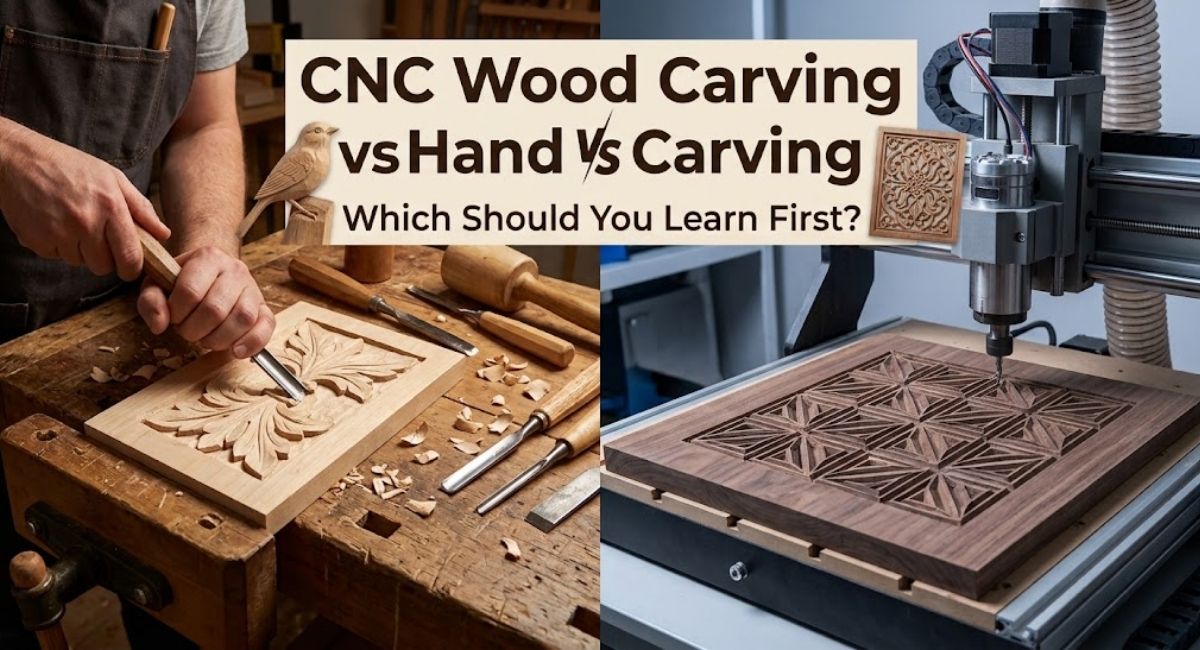
You have a design in your head and a piece of wood on the bench. Now comes the difficult question: should you shape it by hand with chisels and gouges, or let a machine cut the design for you?
The debate around cnc wood carving vs hand carving often becomes unnecessarily extreme. Some woodworkers treat CNC technology as if it removes the craft from woodworking. Others assume hand carving is slow, outdated, and impractical when a machine can produce the same pattern in a fraction of the time.
Neither position tells the whole story.
A CNC router and a set of hand carving tools solve different problems. One is built around digital design, repeatability, and mechanical precision. The other is built around direct control, material awareness, and the ability to respond to the wood as you work. Both can produce impressive results. Both require skill. Both also have a learning curve that beginners often underestimate.
The better question is not, “Which method is better?”
It is, “What do I want to be able to make, and what do I want to learn first?”
If you want to create custom signs, relief carvings, repeated patterns, furniture components, or detailed projects from digital files, a CNC carving machine may offer the fastest route toward those goals. If you want to understand grain direction, tool control, surface shaping, and the physical process of carving wood, starting with hand carving wood can build a stronger foundation.
For many people, the best long-term answer is both. But beginners still need a starting point.
This guide compares CNC carving and hand carving in practical terms. We will look at the tools, costs, learning curves, creative possibilities, safety considerations, project types, and skills involved. By the end, you should have a clear idea of whether to begin with a chisel and gouge or a CNC router for wood.
CNC Wood Carving vs Hand Carving at a Glance
Before getting into the details, here is the simplest comparison.
| Factor | CNC Wood Carving | Hand Carving |
| Learning focus | Software, machine setup, feeds, tooling | Tool control, grain reading, shaping |
| Speed | Fast after setup | Slower for most large or repeated work |
| Repeatability | Excellent | Limited |
| Creative freedom | Strong within digital design workflow | Very flexible and immediate |
| Startup cost | Usually higher | Usually lower |
| Physical feel | Indirect, machine-based | Direct contact with the wood |
| Best for repetition | Excellent | Poor |
| Best for one-off sculptural work | Good with advanced setup | Excellent |
| Skill development | Digital fabrication and CNC workflow | Traditional carving fundamentals |
This table is useful, but it does not answer the bigger beginner question. A faster method is not automatically easier to master. A traditional method is not automatically more artistic.
The real difference lies in what each process asks you to learn.
What CNC Wood Carving Actually Means
CNC stands for computer numerical control. In wood carving, a computer controls the movement of a cutting tool along programmed paths.
A typical CNC workflow looks something like this:
- Create or obtain a digital design.
- Convert the design into toolpaths.
- Choose the correct bit and cutting settings.
- Secure the wood to the machine.
- Set the work origin and machine position.
- Run the carving process.
- Sand, clean, or hand-finish the final piece.
The machine does not simply understand a picture and carve it automatically. The design must be translated into instructions that the machine can follow. This usually involves CAD or design software and CAM software, depending on the project and machine.
A CNC router is one of the most common machines used for woodworking. It can cut, engrave, shape, pocket, and carve wood with a spinning bit that moves along the X, Y, and Z axes.
Entry-level machines such as the X-Carve helped make desktop and hobbyist CNC work more accessible to home woodworkers. More advanced CNC systems can offer larger work areas, greater rigidity, higher production capacity, and additional capabilities.
For a beginner, the appeal is easy to understand. You can take a digital design and create detailed patterns that would require a long time to carve by hand.
But the machine introduces a different set of skills.
You need to understand:
- Digital design or file preparation.
- Toolpath generation.
- Bit selection.
- Feed rates and spindle speeds.
- Material hold-down methods.
- Machine calibration.
- Dust collection.
- Machine safety.
- Work zero and coordinate setup.
That means CNC carving is not “pressing a button and getting art.” The physical cutting is automated, but the preparation is not.
What Hand Carving Wood Actually Requires
Hand carving is the direct shaping of wood using manually controlled tools.
Depending on the project, those tools may include:
- Carving knives.
- Straight chisels.
- Gouges.
- V-tools.
- Veiners.
- Mallets.
- Rasps.
- Rifflers.
A beginner working on a small relief carving might use only a few basic tools. A more experienced carver may build a much larger collection.
The key difference is that every cut is controlled directly by the person carving. You decide where the tool enters the wood, how deep it goes, what angle it takes, and when to stop.
This creates a different relationship with the material.
When you carve by hand, you quickly notice that wood has a personality. Grain can support a clean cut or cause fibers to lift and tear. A sharp gouge can glide smoothly in one direction and catch in another. A dense hardwood may require more force than basswood. A knot can change the way a tool behaves completely.
That feedback is one of the biggest advantages of starting with hand carving.
For a closer look at selecting tools, see our guide to wood carving chisel sets for beginners. Beginners do not need every tool available, but starting with the right basic shapes makes learning much easier.
The Real Debate: Is CNC Carving Better Than Hand Carving?
The short answer is no.
CNC carving is better for some jobs. Hand carving is better for others.
Asking “is CNC carving better than hand carving” is similar to asking whether a table saw is better than a hand saw. The answer depends on the task.
A table saw is faster and more consistent when cutting repeated straight pieces. A hand saw can make cuts in situations where the table saw is impractical. Neither tool replaces the other in every situation.
The same logic applies to wood carving.
A CNC machine can produce ten identical carved panels with a high degree of consistency. A hand carver would need much more time to produce the same quantity, and each panel would likely have slight differences.
Now consider a sculptural figure with subtle organic shapes. A hand carver can respond to the form as it develops. The artist can change a curve halfway through the project. They can remove more material from one area because the wood suggests a different shape.
A CNC machine can produce complex three-dimensional forms, but changing the design usually means returning to the digital model, adjusting the file, regenerating toolpaths, and setting up the work again.
The difference is not about quality. It is about process.
Why Hand Carving Is Often the Better First Skill
For many complete beginners, hand carving is the stronger place to start.
Hand Carving Teaches You How Wood Behaves
Before software, toolpaths, and machine coordinates, there is the material itself.
Hand carving teaches you to read grain direction. You feel the resistance of the wood. You recognize when a tool is sharp enough and when it needs attention. You also begin to understand how different woods react to cutting.
These skills remain valuable even if you later move to CNC work.
A CNC router can make precise cuts, but it cannot prevent every problem caused by poor material choice or incorrect setup. Tear-out, chip-out, burning, vibration, and poor surface quality can still occur.
Someone who understands wood has an advantage when troubleshooting those problems.
The Barrier to Starting Is Lower
A basic hand carving setup can cost far less than a CNC machine.
You can start with:
- A suitable piece of wood.
- One or two quality carving tools.
- A carving knife or small gouge.
- Basic safety equipment.
- A way to secure the work.
You do not need a dedicated computer, CNC software, a large work area, or a dust extraction system designed around machine use.
This makes hand carving accessible to people who want to test the craft before making a major investment.
Hand Carving Builds Tool Control
A sharp tool is only as effective as the person holding it.
Hand carving develops:
- Pressure control.
- Directional control.
- Depth control.
- Tool angle awareness.
- Spatial awareness.
- Grain reading.
These skills take time to build. The good news is that even simple projects can teach them.
A small spoon, leaf, geometric relief, or animal figure can provide useful practice without requiring a large workshop.
If you are completely new to the craft, our guide on wood carving for beginners can help you build those first practical skills before taking on more complex work.
It Encourages Problem-Solving in Real Time
A hand carving rarely goes exactly as planned.
You may notice a weak area in the grain. A detail may need to be simplified. A curve may look better after removing more material. These decisions happen while your hands are on the wood.
That ability to adapt is a valuable part of traditional carving.
Why CNC Wood Carving May Be the Better First Choice for Some Beginners
Hand carving is not automatically the right starting point for everyone.
There are several situations where beginning with a CNC carving machine makes more sense.
You Already Enjoy Digital Design
If you are comfortable using design software and enjoy working with digital files, CNC may feel natural.
You might already have experience with:
- CAD.
- 3D modeling.
- Graphic design.
- Vector files.
- Digital fabrication.
- 3D printing.
In that case, the biggest challenge may not be the software side. It may be learning how digital designs translate into physical wood.
A person who can already design clean vectors may quickly begin producing signs, engraved panels, and decorative work with a CNC router.
You Want to Make Repeated Products
Repeatability is one of the strongest arguments for CNC.
Imagine making custom wooden signs for customers. If you need to produce the same logo or design many times, carving every piece by hand may not be practical.
A CNC router allows you to use the same file repeatedly. Once the workflow is set up correctly, you can reproduce the design with consistent dimensions.
This does not mean the final piece has to look mass-produced. Many makers use CNC technology for the rough or detailed cutting and then add hand-finishing afterward.
You Need Complex Geometric Accuracy
Machines are particularly useful for work that demands consistent spacing, symmetry, or repeated geometric patterns.
For example:
- Inlays.
- Decorative panels.
- Repeated lettering.
- Precision pockets.
- Detailed signs.
- Furniture parts.
- Layered reliefs.
Hand carving can create some of these results, but the process may take longer and require a higher level of technical skill.
You Prefer Designing Before You Build
Some makers enjoy planning the project in detail before touching the material.
CNC work supports this style well.
You can design a piece digitally, inspect proportions, simulate parts of the process, and make changes before cutting the wood. This can reduce material waste, especially when working with expensive hardwood.
CNC vs Hand Carved Wood: The Biggest Difference Is Repeatability
When comparing CNC vs hand carved wood, repeatability is the most obvious dividing line.
A CNC machine follows programmed instructions. If the material is positioned correctly and the machine is calibrated, the same design can be produced repeatedly.
A hand-carved piece is different.
Even if an experienced carver follows a pattern, each piece contains small variations. The pressure of the tool, grain direction, wood density, and the carver’s decisions can all create differences.
For some projects, variation is a problem.
For others, variation is the point.
A set of decorative architectural panels may need to match perfectly. CNC is highly useful here.
A carved bowl, figurine, or decorative sculpture may benefit from subtle variation. Hand carving can make that variation part of the work’s character.
Neither approach is more legitimate. The intended result matters.
Speed: CNC Is Faster Only After the Setup Work
One of the most common misconceptions is that CNC is always faster.
The actual answer is more complicated.
CNC Time
A CNC project may require time for:
- Creating the design.
- Preparing the file.
- Generating toolpaths.
- Selecting bits.
- Securing the workpiece.
- Setting the origin.
- Running the machine.
- Changing bits.
- Cleaning up tabs or rough edges.
- Sanding and finishing.
The machine may perform the cutting while you do something else, but the total project time can still be significant.
A small, simple hand-carved object may actually be faster than preparing a complete CNC workflow.
Hand Carving Time
Hand carving generally becomes slower as the amount of material and level of detail increase.
However, the setup is minimal.
You can sketch directly on the wood, pick up a tool, and begin.
For a one-off project, that direct approach can save time.
For repeated production, CNC often gains the advantage because the design and setup work can be reused.
The Learning Curve: Which Is Easier?
This depends on the type of difficulty you prefer.
Hand carving has a physical learning curve.
CNC carving has a technical and digital learning curve.
The Hand Carving Learning Curve
At first, beginners struggle with:
- Keeping tools sharp.
- Controlling cuts.
- Reading grain direction.
- Avoiding tear-out.
- Choosing the right tool shape.
- Using safe hand positions.
The feedback is immediate. If you make a poor cut, you can see it.
The basics are also easy to access. You can practice one skill at a time.
The CNC Learning Curve
CNC introduces more connected variables.
A poor result might be caused by:
- An incorrect toolpath.
- The wrong bit.
- Improper feed rate.
- Poor workholding.
- Incorrect machine zero.
- Loose components.
- Software settings.
- Material movement.
Troubleshooting can take time because the source of the problem is not always obvious.
However, once you build a repeatable workflow, CNC work can become more predictable.
Tools: What You Need for Each Method
A common beginner mistake is to compare the cost of one hand tool with the price of a complete CNC system. A better comparison looks at the whole working setup.
A Basic Hand Carving Setup
A beginner does not need a wall covered in tools.
A practical starting setup may include a carving knife, one or two gouges, a chisel, sharpening equipment, a work-holding solution, and eye protection.
As your projects become more advanced, you can add specialized tools.
Understanding the shapes and uses of gouges is particularly important. A gouge is not simply a curved chisel. Different sweeps and profiles create different cuts and shapes. You can see a fuller breakdown in our article on wood carving gouges.
A Basic CNC Setup
A CNC system involves more components.
You may need:
- The machine.
- A computer.
- Design software.
- CAM software.
- Router bits or end mills.
- Workholding equipment.
- Dust collection.
- Safety equipment.
- A stable work surface.
- Measuring and setup tools.
The exact requirements depend on the machine.
A small desktop CNC router may fit in a compact workshop. A larger machine requires more space and infrastructure.
If you are considering machine-based carving, our detailed guide to choosing a wood carving machine provides useful context on the types of machines available and where they fit into woodworking.
Cost: Hand Carving Usually Has the Lower Entry Price
For most beginners, hand carving costs less to start.
You can build a basic kit gradually and add tools when your projects demand them.
CNC requires a larger initial investment. Even after buying the machine, you may need software, bits, dust management, and workholding accessories.
However, cost should not be viewed only as the purchase price.
If your goal is to produce repeated items, a CNC machine may eventually save time. Time has value, especially for a hobbyist woodworking business.
The right question is not simply, “Which is cheaper?”
Ask:
- How often will I use it?
- What will I make?
- Do I have space for the equipment?
- Will I enjoy the workflow?
- Does the tool support my long-term goals?
Buying a CNC router because it looks impressive is not a good reason. Buying one because it solves a specific production or design problem is more practical.
Creative Freedom: Both Methods Offer It in Different Ways
People sometimes assume hand carving is more creative because every cut is made by hand.
That is too simple.
A CNC machine can produce highly original work. The machine does not choose the design, composition, material, or artistic direction. The maker still makes those decisions.
The creative freedom simply happens at a different stage.
Hand Carving Creativity
Hand carving encourages direct improvisation.
You can change a form while you work. You can follow the grain. You can allow the natural character of the wood to influence the final piece.
CNC Creativity
CNC carving encourages planning and design development.
You can create detailed digital patterns, test proportions, combine elements, and reproduce complex forms that would be difficult to execute manually.
The strongest makers often use both forms of creativity.
They design digitally where precision matters and work by hand where touch and judgment matter.
The Hybrid Method: CNC Roughing and Hand Finishing
The idea that you must choose one method forever is false.
Many woodworkers use a hybrid workflow.
A CNC router can remove large amounts of material or create the main relief pattern. Then hand tools refine the surface.
For example, a CNC machine could:
- Cut the outline.
- Remove background material.
- Rough out the main form.
- Carve repeated patterns.
Then the maker could use chisels and gouges to:
- Soften transitions.
- Add fine texture.
- Correct machine marks.
- Improve facial features.
- Create hand-cut details.
- Give the work a less uniform appearance.
This approach can offer the efficiency of machine work and the expressive control of hand carving.
It is particularly useful for professional projects that require both speed and individuality.
Surface Quality and Finish
Both methods can produce excellent surfaces, but they leave different evidence behind.
A hand tool can leave intentional facets, crisp cuts, or smooth surfaces depending on the carver’s technique.
A CNC machine may leave tool marks, especially on curved surfaces. The quality of the surface depends on factors such as:
- Step-over.
- Bit shape.
- Feed rate.
- Wood species.
- Machine rigidity.
- Tool sharpness.
A smaller step-over can improve the surface, but it also increases machining time.
Hand finishing is often required for CNC projects, especially when the final piece is intended to have a polished appearance.
This is another reason why traditional carving skills remain useful even in a machine-equipped workshop.
Safety: Different Risks, Same Need for Care
Neither method should be treated casually.
Hand Carving Safety
The biggest risk is usually direct contact with sharp tools.
Safe habits include:
- Keeping hands behind the cutting edge.
- Securing the workpiece.
- Using controlled cuts.
- Keeping tools sharp.
- Avoiding unnecessary force.
- Wearing appropriate protective equipment.
A dull tool can actually increase risk because it requires more force and offers less control.
For a broader understanding of tool choice, maintenance, and safe use, review our resource on how to sharpen wood carving tools. Sharpening is not a separate skill from carving. Tool condition directly affects the quality and control of every cut.
CNC Safety
CNC systems create different hazards.
These may include:
- High-speed rotating bits.
- Flying debris.
- Dust.
- Noise.
- Material movement.
- Bit breakage.
- Unexpected machine motion.
Never assume that automated means safe.
The machine should be monitored appropriately, and the workpiece must be secured correctly. Dust collection is especially important because fine wood dust can affect both health and workshop cleanliness.
What About the “Handmade” Question?
This issue matters to some makers and buyers.
A hand-carved object clearly involves direct manual cutting. A CNC-produced object involves a computer-controlled machine.
That does not mean CNC work is dishonest or lacking in skill.
However, the description should be accurate.
If a product is CNC carved, calling it “hand carved” would misrepresent the process. If a maker uses a CNC machine for roughing and completes the details by hand, the product description should explain that workflow clearly.
Honest labeling builds trust.
The question of whether a piece feels handmade is also more complex than the tool used. A maker can spend hours designing, setting up, machining, refining, sanding, and finishing a CNC piece.
The real value comes from the quality of the work, the skill involved, and the transparency of the process.
When Should You Start With Hand Carving?
Start with hand carving first if most of these statements describe you:
- You are completely new to woodworking.
- You want a low-cost entry point.
- You enjoy working directly with materials.
- You want to make one-off objects.
- You are interested in sculpture or traditional carving.
- You want to improve your understanding of grain and cutting tools.
- You have limited workshop space.
- You do not enjoy spending long periods working with software.
Hand carving is especially useful for people who want to experience the core relationship between tool and wood.
It can also make you more confident around woodworking tools in general.
When Should You Start With CNC Wood Carving?
Consider starting with CNC if these goals fit you better:
- You already have digital design skills.
- You want to create repeated products.
- You need accurate geometric details.
- You enjoy computer-based design.
- You want to make signs or decorative panels.
- You are interested in digital fabrication.
- You have the budget and workspace for a machine.
- You want to combine woodworking with technology.
A hobbyist who wants to build a small business producing personalized products may find that a CNC router for wood fits their goals better than developing advanced hand carving skills first.
Again, that does not make the machine an easier path. It simply makes the path more aligned with the intended work.
Three Real-World Scenarios
Scenario 1: The Weekend Beginner
Imagine someone with a small workspace who wants to make carved ornaments, spoons, and simple decorative pieces.
A CNC machine would require a large investment and additional setup.
Hand carving makes more sense. A few carefully chosen tools and suitable wood can provide months of practice.
Scenario 2: The Custom Sign Maker
Now imagine someone who wants to create personalized wooden signs with names, logos, and repeated designs.
Hand carving every letter may be possible, but CNC offers clear advantages in accuracy and repeatability.
This person may benefit from learning basic woodworking and finishing skills while building CNC knowledge from the beginning.
Scenario 3: The Serious Carver
Consider an experienced hand carver who wants to speed up the roughing stage of larger projects.
A hybrid workflow may be ideal.
The CNC machine removes bulk material and handles repeatable areas. The carver finishes the form by hand.
This can reduce production time without giving up artistic control.
How to Decide Without Regretting Your Choice
Before buying anything expensive, answer five questions.
What do I want to make?
This is the most important question.
Write down five projects you want to complete in the next year.
If they are mostly signs, engraved panels, geometric patterns, and repeated products, CNC may fit.
If they are mostly figures, spoons, sculptures, and unique objects, hand carving may fit better.
How much do I enjoy software?
Be honest.
CNC requires comfort with digital workflows. You can learn them, but if you strongly dislike working with software, the process may become frustrating.
What is my budget?
Include the full setup cost.
Do not compare the price of a machine alone with a single hand tool.
How much space do I have?
Hand carving can be done in a small area.
CNC requires space for the machine, computer access, workholding, dust management, and material handling.
Do I want to make one-offs or repeated products?
This single answer can often point you in the right direction.
One-off work generally favors hand carving.
Repeated work generally favors CNC.
A Beginner Roadmap for Hand Carving
If you decide to begin with hand tools, keep the first stage simple.
Start by learning to make controlled cuts in inexpensive practice wood. Focus on grain direction and sharp tools.
A sensible progression could look like this:
- Practice basic cuts.
- Carve simple geometric shapes.
- Complete a small relief carving.
- Try a spoon or decorative object.
- Add more specialized gouges and chisels.
- Move toward larger or more detailed projects.
Do not rush into buying dozens of tools.
Each new tool should solve a problem that your current tools cannot solve well.
A Beginner Roadmap for CNC Carving
If you choose CNC first, start with simple projects and focus heavily on setup.
Your first projects should teach:
- Machine safety.
- Workholding.
- Coordinate setup.
- Basic toolpaths.
- Bit selection.
- Feed and speed concepts.
- Simple pocketing and engraving.
- Surface finishing.
Do not begin with an elaborate 3D carving just because the machine can theoretically produce one.
Simple projects make it easier to identify and fix problems.
A basic engraved sign can teach more useful fundamentals than an overly complex project that fails halfway through.
The Case for Learning Both
The strongest long-term woodworking skill set may include both CNC and hand carving.
CNC develops:
- Digital design.
- Machine setup.
- Production planning.
- Repeatability.
- Precision.
Hand carving develops:
- Tool control.
- Material awareness.
- Grain reading.
- Surface refinement.
- Direct problem-solving.
These skills complement each other.
A woodworker who can create a design digitally, machine the basic form, and refine it by hand has more options than someone who works with only one process.
You also do not need to become an expert in both at the same time.
Start with the method that best matches your current goals. Add the other when you have a practical reason to do so.
CNC Wood Carving vs Hand Carving: The Verdict
For most complete beginners who want to understand the craft of carving, hand carving is the better skill to learn first.
It has a lower barrier to entry. It teaches you how wood behaves. It develops direct tool control. It can be practiced almost anywhere with a small collection of quality tools.
However, that recommendation changes if your main goal is digital production.
If you want to make repeated products, personalized signs, accurate patterns, or designs created through software, starting with a CNC router can be more practical.
The best answer is based on your intended work.
Choose hand carving first if you want to master the material.
Choose CNC first if you want to master a digital production workflow.
Choose both if you want the widest range of possibilities.
CNC vs Hand Carving: Your Questions Answered
Is CNC carving easier than hand carving?
Not necessarily. CNC removes the need to manually control every cutting movement, but it introduces software, machine setup, toolpaths, workholding, and technical troubleshooting. Hand carving is physically more direct but requires strong tool control.
Can a beginner use a CNC router for wood?
Yes. Many hobbyist woodworking CNC machines are designed for beginners. Start with simple projects and spend time learning setup, safety, workholding, and basic toolpaths before attempting complex three-dimensional carvings.
Is hand carving cheaper than CNC carving?
Usually, yes. A basic hand carving setup can be built gradually. CNC requires a larger initial investment in the machine and related equipment.
Does CNC carving damage the value of handmade woodwork?
Not automatically. The value depends on the design, quality, craftsmanship, finishing, and how honestly the work is described. CNC-made and hand-carved pieces simply involve different processes.
Can I combine CNC and hand carving?
Yes. This is often an effective workflow. A CNC machine can rough out forms or handle repeated details, while hand tools can add refinement, texture, and custom finishing.
Do I need to know how to hand carve before using a CNC?
No. You can begin with CNC without hand carving experience. However, basic knowledge of wood grain, tool behavior, and finishing can still be useful.
Which is better for selling wood carvings?
It depends on what you sell. CNC is usually more practical for repeated products and consistent production. Hand carving is well suited to one-off, custom, and highly individual pieces. A hybrid workflow can support both efficiency and personal craftsmanship.
Final Takeaway
The debate over CNC wood carving vs hand carving does not need a winner.
These methods are different tools for different goals.
If you are standing at the beginning of your woodworking journey and want the strongest connection to the material, start with hand tools. Pick up a sharp chisel or gouge, learn how the grain reacts, and practice making controlled cuts.
If your interests lean toward digital design, precision, and repeatable production, a CNC carving machine may be the more practical starting point.
Most importantly, avoid choosing based on the idea that one method is more legitimate than the other. A good craftsperson chooses the process that fits the project.
Start with one simple project. Build real skills. Pay attention to what parts of the process you enjoy. Then expand your workshop when your goals give you a reason to do so.
For more practical woodworking ideas and carving guidance, browse the helpful resources available at BYB Good Idea and continue building a workshop that matches the way you actually want to create.