

You walk into the store with a budget of $2 per square foot. The sign on the shelf says $1.69. The installer quotes $3.50. The delivery fee, the underlayment, and the trim are not on either number.
By the time the order is final, your “cheap” floor costs three times what you planned. This happens to a lot of homeowners. The plank price is only one piece of the bill.
This guide breaks the full cost into parts. You will see material prices and labor prices shown separately. You will see three price tiers, a list of hidden costs, a simple calculator, and a worked example for a 1,000 square foot home. UK readers get a section in pounds per square metre.
How We Checked These Prices
Prices change often, so every figure here carries a date and a source.
All checks were done on October 21, 2026. The sources were:
- Home Depot product listings for luxury vinyl plank, as shown in web search results on that date
- A Lowe’s promotion for waterproof vinyl plank, as reported by the deal site dealnews
- The Fixr luxury vinyl plank cost guide, for national material and labor ranges
- A 2026 installation guide from HomeGnome, for removal, subfloor, and underlayment costs
- Three UK cost guides from Trade2Base (June 2026), MyJobQuote (July 2026), and Tile Mountain
Floor & Decor is also a major seller of vinyl plank in the USA. I could not confirm a current per square foot price from its listings on the check date, so I have not quoted one. Check the product page for your chosen plank before you budget.
Store prices differ by region, stock, and promotion. Use the numbers below as planning ranges, then get at least two local quotes.
The Answer Is
In the USA, most homeowners pay about $5 to $12 per square foot for vinyl plank installed, according to Fixr (checked October 21, 2026). The plank itself runs from about $1.50 to $10 per square foot. Labor adds roughly $1.50 to $6 per square foot.
For a quick budget, use these working numbers:
Budget floors land near $3 to $5 per square foot installed. Mid-range floors land near $5.50 to $8. Premium floors land near $9 to $14 or more.
In the UK, expect about £25 to £70 per square metre fitted for luxury vinyl, depending on the tier (Tile Mountain, checked October 21, 2026).
What Drives Vinyl Plank Flooring Cost
Five things move the price more than anything else.
Wear Layer Thickness
The wear layer is the clear coating over the printed wood image. It is measured in mil, where one mil is one thousandth of an inch.
Cheap planks often carry a 6 mil layer. Mid-range planks usually sit at 12 to 20 mil. Premium planks may reach 22 to 30 mil. A thicker layer costs more but protects the floor for longer in busy homes.
Core Type
Luxury vinyl plank (LVP) comes in a few core types. SPC stands for stone plastic composite. It has a dense, hard core that resists dents. WPC stands for wood plastic composite. It has a softer, foamed core that feels warmer underfoot.
Rigid core planks usually cost more than flexible glue-down vinyl. SPC and WPC often fall in a similar range, and the exact price depends on the brand and wear layer.
Installation Method
Click-lock planks float over the subfloor. They are fast to install and friendly for DIY. Glue-down planks bond to the subfloor. They take longer and can raise labor cost, but they suit commercial areas and some slabs. Peel-and-stick planks are the cheapest to buy and install, though they are thinner. The page on peel and stick vinyl flooring covers their trade-offs.
Brand and Retailer
Home Depot, Lowe’s, and Floor & Decor sell store brands and national brands. Mohawk, Shaw, Pergo, and Lifeproof all sell LVP lines. Fixr lists Mohawk LVP at about $2 to $4 per square foot (checked October 21, 2026). Brand name matters less than wear layer, core, and warranty.
Region
Labor rates are higher in big cities and in areas with few installers. A job that costs $2 per square foot in labor in one state can cost $5 in another.
Vinyl Plank Price Tiers: Materials and Labor Shown Separately
The table below splits the price into material and labor. The ranges are planning estimates built from the dated sources above. Material means the plank only. Labor means installation of the plank only. Hidden costs come later.
| Tier | Wear Layer | Material per sq ft | Labor per sq ft | Installed per sq ft |
| Budget | 6 to 12 mil | $1.20 to $2.50 | $1.50 to $2.50 | $2.70 to $5.00 |
| Mid-range | 12 to 22 mil | $2.50 to $4.50 | $2.00 to $4.00 | $4.50 to $8.50 |
| Premium | 20 to 30 mil | $4.50 to $8.00 | $3.00 to $6.00 | $7.50 to $14.00 |
Prices checked October 21, 2026. Material ranges draw on Home Depot listings, Lowe’s promotions, and the Fixr guide. Labor ranges draw on Fixr and HomeGnome.
Budget Tier
At the budget end, Home Depot listed several glue-down luxury vinyl planks with a 6 mil wear layer between $1.19 and $2.17 per square foot (seen October 21, 2026). One 12 mil glue-down plank showed at $1.89 per square foot on the same date.
These floors work for rental units, low-traffic bedrooms, and quick flips. They are thin, so they scuff sooner. They also tend to come with shorter warranties.
A click-lock Lifeproof plank at 6 mil showed $2.89 per square foot on Home Depot that day. Click-lock costs more than glue-down at the same wear layer, because the plank is thicker and has a locking edge.
Mid-Range Tier
Most homes should look here. Planks in this tier have 12 to 22 mil wear layers, rigid cores, and often an attached pad.
A recent dealnews report showed Lowe’s selling waterproof vinyl plank from $1.99 per square foot on sale, with wider planks at $2.99 (seen October 21, 2026, promotion dates not confirmed). Treat that as a sale floor, not a normal shelf price. Regular prices for 20 mil and 22 mil planks from brands such as Pergo and STAINMASTER sit higher.
A Shaw 20 mil click-lock plank with attached pad listed at $4.19 per square foot on Home Depot (seen October 21, 2026). That is a good marker for the upper middle of the tier.
Premium Tier
Premium planks have 22 to 30 mil wear layers, wide formats such as 9 inch by 60 inch, embossed textures that match the wood grain, and longer warranties. You may also see cork or foam pads attached to the back.
Material prices can pass $6 per square foot. Labor tends to cost more too, because long planks and tight pattern matching take care. Fixr gives a full material range up to $10 per square foot for luxury vinyl plank.
Labor Cost to Install Vinyl Plank
Fixr puts labor for LVP at $1.50 to $6 per square foot (checked October 21, 2026). Most simple jobs fall in the lower half of that range. The upper end covers stairs, tricky layouts, and premium glue-down jobs.
Several things push labor up:
- Stairs and landings, which cost far more per step than flat floor
- Rooms with many corners, closets, or odd angles
- Glue-down installation instead of click-lock
- Poor subfloor condition
- Pattern work such as herringbone
Large open rooms are cheaper per square foot. An installer can lay long straight runs fast. A small bathroom with a toilet, a vanity, and a tub takes nearly as long as a larger room, so it often costs more per square foot.
If you want to save on labor, floating click-lock planks in simple rooms are the best DIY candidates. The guide to DIY flooring ideas can help you judge which jobs to attempt.
Hidden Costs Most Quotes Leave Out
These items show up after you sign. Add them to your budget early.
Subfloor Prep
The subfloor must be flat, dry, and clean. Low spots and bumps will show through thin vinyl and can stress click joints.
HomeGnome lists subfloor replacement at $2 to $7 per square foot and removal of old flooring at $1 to $4 per square foot (checked October 21, 2026). Leveling compound, patching, and sanding often add a few hundred dollars for a typical room.
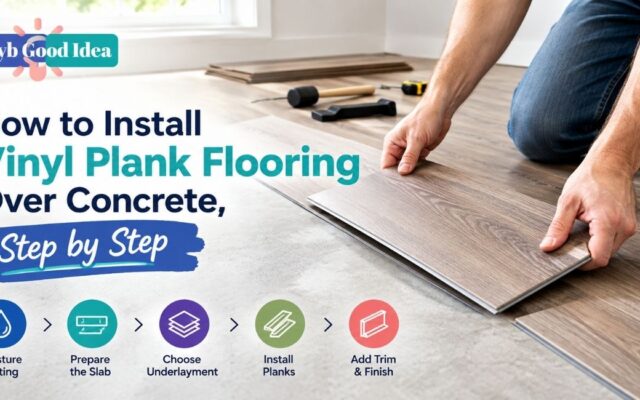
Concrete slabs need a moisture test. If readings are high, you may need a vapor barrier or a sealer first. The walkthrough on installing vinyl plank flooring over concrete explains the checks in simple steps.
Underlayment
Many modern planks have a pad attached, so you may not need a separate underlayment. If yours does not, a separate pad adds cost. It also adds sound control and comfort.
Underlayment prices vary widely. Cheap foam can cost under $0.50 per square foot. Premium moisture-barrier products cost more. Do not double up on pads if your plank already has one, since extra padding can void the warranty. Before you buy, read the guide to underlayment for vinyl flooring.
Trim, Transitions, and Baseboards
Planks stop at doorways, stairs, and where they meet other floors. Each of those edges needs a transition strip. You may also need quarter round, shoe moulding, or new baseboards.
A small home can easily spend $200 to $600 on trim and transitions. Premium wood or color-matched trim costs more.
Furniture Moving
Some installers charge to move heavy furniture, appliances, and pianos. Others ask you to clear the room. Ask about it before the job date, not on the day.
Old Floor Removal and Disposal
Carpet is quick to remove. Tile, glued wood, or old vinyl takes much longer. Disposal fees or dumpster rental can add another $100 to $400. Sticky glue and thin-set may call for a floor stripper or grinding before the new floor goes down.
Baseboard Removal and Door Trimming
Doors may need to be trimmed so they swing over the new floor. Baseboards may need to come off and go back on. These are small line items that add up.
Delivery and Waste
Planks are heavy. A pallet delivery can carry a fee. Order extra for cuts, mistakes, and future repairs, which brings us to the waste factor.
Waste Factor: How Much Extra to Order
The waste factor is the extra material you order beyond the room size. It covers cuts, damaged planks, and offcuts you cannot reuse.
Use these starting points:
- 5 to 7 percent for simple rectangular rooms laid straight
- 10 percent for most homes with closets and doorways
- 12 to 15 percent for diagonal layouts, herringbone, or rooms with many angles
Also keep one extra box from the same lot. Colors can vary slightly between production runs. A plank bought two years later may not match.
A Simple Room Calculator
You do not need an app. Use these five steps for any room.
Step 1: Measure. Multiply length by width in feet. A room that is 12 feet by 15 feet equals 180 square feet. For L-shaped rooms, split the area into rectangles and add them.
Step 2: Add waste. Multiply the area by 1.10 for a 10 percent waste factor. For 180 square feet, that gives 198 square feet.
Step 3: Convert to boxes. Divide by the coverage of one box. If a box covers 20 square feet, 198 divided by 20 equals 9.9. Round up to 10 boxes. That is 200 square feet of material.
Step 4: Price the material. Multiply the box count by the box coverage and by the price per square foot. At $3.50 per square foot, 200 square feet equals $700.
Step 5: Add labor and extras. Multiply the room area (not the waste area) by the labor rate. At $2.50 per square foot, 180 square feet equals $450. Then add underlayment, trim, removal, and disposal.
Worked Example: A 180 Square Foot Bedroom
Here is the same room with mid-range planks. Prices are working estimates, dated October 21, 2026.
Material, 200 square feet at $3.50: $700. Labor, 180 square feet at $2.50: $450. Underlayment, 180 square feet at $0.60: $108. Trim and transitions: about $100. Disposal: about $50.
Total: about $1,408, or roughly $7.80 per square foot of finished floor.
Notice how the finished cost per square foot is higher than the plank price. That gap is why quotes feel so different from shelf tags.
Vinyl Plank Flooring Cost for 1,000 Square Feet
A 1,000 square foot project is common for a whole floor or a small home. The table below uses a 10 percent waste factor on materials and charges labor on the finished area. It does not include hidden costs.
| Tier | Material (1,100 sq ft) | Labor (1,000 sq ft) | Subtotal |
| Budget at $1.80 and $2.00 | $1,980 | $2,000 | $3,980 |
| Mid-range at $3.50 and $3.00 | $3,850 | $3,000 | $6,850 |
| Premium at $5.50 and $4.50 | $6,050 | $4,500 | $10,550 |
Prices checked October 21, 2026. Based on the tier ranges above. Fixr lists a full-range total of $3,000 to $16,000 for 1,000 square feet.
Now add the extras. A home this size might need $500 to $1,500 for trim and transitions, $200 to $800 for underlayment if needed, $1,000 to $4,000 for old floor removal, and $0 to $7,000 or more for subfloor repair. Most homes do not need every extra, but plan a buffer of 10 to 15 percent.
DIY vs Hiring a Pro
If you install it yourself, you save the labor line. On a 1,000 square foot job at $3 per square foot, that is about $3,000. You still pay for tools.
Basic tools include a utility knife, a tapping block, a pull bar, spacers, a measuring tape, and a saw. Many stores rent or sell low-cost kits. Click-lock LVP is one of the more forgiving floors for beginners, if the subfloor is flat.
Hire a pro when you have stairs, a glue-down job, a very uneven subfloor, or a short deadline. A good installer also protects your warranty. Many warranties need proper installation, and a poor job can void coverage.
Ask for written quotes that split out:
- Material cost and quantity
- Labor per square foot
- Removal and disposal
- Subfloor prep
- Trim and transitions
- Furniture moving
A single lump sum makes it hard to compare bids.
Vinyl Plank Costs in the UK
Many UK buyers search for LVT, which stands for luxury vinyl tile. In the UK market, the term covers both plank and tile formats. Prices are shown per square metre, and one square metre equals about 10.76 square feet.
Tile Mountain (checked October 21, 2026) gives these tiers:
Entry-level luxury vinyl costs £20 to £25 per square metre for the product, and £25 to £35 fitted. Mid-range costs £25 to £40 supply only, and £35 to £50 fitted. Premium costs £40 to £60 supply only, and £55 to £70 fitted.
MyJobQuote (July 28, 2026) reports a wider range of £20 to £60 per square metre for supply and £20 to £40 per square metre for fitting. That gives a total of £40 to £100 per square metre in some cases. The spread reflects regional rates and subfloor needs.
Trade2Base (June 2026) lists plywood overlay on a timber subfloor at £12 to £20 per square metre, and scotia or beading at £4 to £9 per linear metre supplied and fitted. These are useful reminders that prep and trim sit outside the plank price.
To compare with the USA, a mid-range UK floor at £35 to £50 per square metre works out to roughly £3.25 to £4.65 per square foot fitted. That is lower than most US installed prices, though labor, materials, and subfloors differ by country.
LVP vs LVT: Does the Name Change the Price?
The two terms are often mixed up. Plank means a long, wood-look format. Tile means a square or rectangular stone-look format. In the USA, LVP and LVT sit in similar price ranges for the same quality. HomeGnome and others show that tiles cost a bit more in some lines because of grout-look edges and stone patterns. The guide to LVP vs LVT lays out the differences in plain terms.
Vinyl Plank vs Hardwood on Price
Vinyl plank costs less than real wood in almost every case. Hardwood adds sanding, finishing, and longer installation time. It also adds more risk if moisture is present.
If you are weighing the two, the cost to install hardwood flooring page shows the same breakdown for solid wood. For a closer match, the comparison of vinyl plank vs engineered hardwood covers cost, durability, and resale in one place.
Ways to Lower Your Total Cost
You can cut the bill without buying a bad floor.
Pick a mid-range plank on sale instead of a premium plank at full price. Choose standard plank widths. They waste less and install faster. Order the right amount with a sensible waste factor. Buy from a store with a good return policy, since unopened boxes can often be returned.
Remove old carpet yourself. Many installers charge extra for removal, and carpet comes up fast with basic tools. Move your own furniture. Buy trim in bulk, and paint baseboards yourself. Get three quotes and ask each to itemize the work.
Avoid the cheapest floor in a busy kitchen or hallway. A $1.19 plank with a 6 mil wear layer may need replacing sooner than a $3.50 plank with 20 mil. Over ten years, the cost per year can favor the better plank.
Is Vinyl Plank Worth the Money?
It depends on the room and your plan.
Vinyl plank earns its price in wet and high-wear rooms. It is waterproof in rigid core form, easy to clean, and softer underfoot than tile. It also handles pets and kids well.
It does not add the same resale feel as real hardwood in every market. It cannot be sanded and refinished. A deep gouge usually means a plank swap.
For rentals, basements, kitchens, and family homes, it is often the best value. For a forever home with a premium finish, some owners prefer wood and accept the higher cost.
Questions About Vinyl Plank Flooring Cost
How much does vinyl plank flooring cost per square foot?
Plank prices range from about $1.50 to $10 per square foot for materials. Installed prices commonly fall between $5 and $12 per square foot, according to Fixr (checked October 21, 2026). Budget floors can land near $3 to $5 installed.
How much does vinyl plank flooring cost for 1,000 square feet?
A budget job can total about $4,000. A mid-range job often totals $6,500 to $7,500. A premium job can pass $10,000. Add 10 to 15 percent for hidden costs.
Is it cheaper to install vinyl plank yourself?
Yes. You save the labor cost, which is often $2 to $4 per square foot. You still pay for tools, trim, and any prep. A mistake can cost more than the savings, so start with a small, simple room.
How much extra vinyl plank should I order?
Order 7 to 10 percent extra for most rooms. Order 12 to 15 percent for diagonal or herringbone layouts. Keep one spare box from the same lot for future repairs.
Do I need underlayment for vinyl plank?
Only if your plank has no attached pad. Many rigid core planks come with one. Check the warranty before you add a separate layer.
Is thicker vinyl plank always better?
Not always. Wear layer thickness matters more than total plank thickness. A thick plank with a thin wear layer will still scuff. Check the mil rating first.
Does vinyl plank cost less than laminate?
They often overlap in price. Laminate can be cheaper in the lowest tier, but vinyl plank is waterproof and handles damp rooms better. Compare specific products, not just categories.
Final Thoughts
Plan for the full cost, not just the shelf tag. A $2 plank becomes a $5 to $8 floor once you add labor, underlayment, trim, and waste.
Start with these steps:
- Measure each room and add a waste factor.
- Choose a tier based on traffic, wear layer, and warranty.
- Ask each installer for an itemized quote.
- Test the subfloor before you order.
- Add a 10 to 15 percent buffer for surprises.
Prices change often, so recheck the product page and your local quotes before you order. Use the dates in this guide as a guide, not a guarantee.
For more flooring budgets, comparisons, and DIY guides, keep reading at BYB Good Idea. Pick your room, run the numbers, and make the call with a clear total in hand.